If you live with chronic pain you have been promised a lot of things, and most of them arrived with a testimonial instead of a study. This article is written the other way around.
What does the research actually show?
The most cited work here comes from a Japanese research group studying Waon therapy, a repeated whole-body far-infrared warming protocol. In a 2005 study of 46 people with chronic pain, adding daily infrared sessions to a hospital pain program brought anger scores down further, and two years later 77% of the sauna group were back at work, against 50% of the group without it. In a 2008 study of 13 women with fibromyalgia, pain dropped by about half after the first session and stayed lower across ten sessions; that study had no comparison group. A separate 2009 Dutch pilot in 34 people with rheumatoid arthritis and ankylosing spondylitis reported short-term improvements in pain and stiffness with no adverse effects recorded.
There is also a larger body of evidence about sauna bathing in general, led by a Finnish study that followed over 2,300 men for about 20 years and linked frequent sauna use with fewer fatal heart events and lower mortality. That research is about traditional saunas rather than infrared, and it is observational, so it tells you about correlation in a population rather than about your back.
What does the research NOT show?
- It does not show a cure. Nothing in this literature claims to resolve a chronic pain condition.
- The trials are small, often a few dozen participants, and several lack the kind of control group that would rule out the effect of simply lying somewhere warm and quiet for forty-five minutes.
- It does not show that infrared beats a traditional sauna, a hot bath, or a heating pad on any head-to-head measure. Almost nobody has run that comparison properly.
- It says nothing about detoxification. Sweat is mostly water and salt; your liver and kidneys do that work. Any studio selling you sauna as detox is selling past the evidence.
- Chromotherapy, the colored light, has thin evidence and we treat it as atmosphere rather than medicine. We say so on the service page too.
Why might heat help pain at all?
The plausible mechanisms are unglamorous and well established. Heat increases local blood flow, which is why a warm compress helps a stiff joint. Heat reduces muscle guarding, the low-grade protective tension that builds around a painful area and eventually becomes its own source of pain. And deliberate heat exposure reliably drops people into parasympathetic rest, which is the state where pain perception tends to soften.
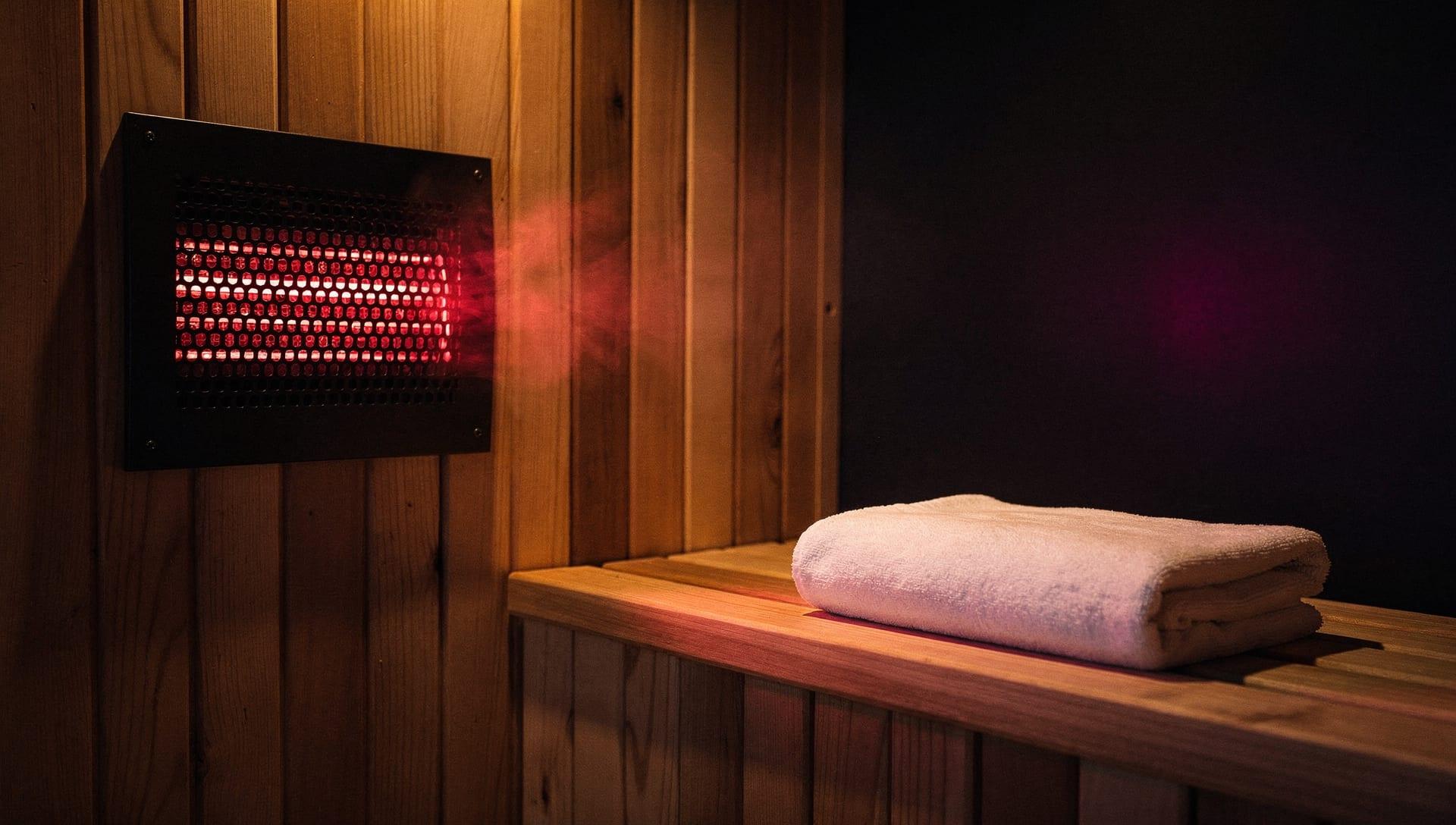
Infrared's specific contribution is comfort, not magic. Because the emitters warm your tissue directly rather than heating the air to 180 degrees, you can stay in for forty-five minutes without the respiratory discomfort that makes many people with chronic conditions avoid traditional saunas entirely. Longer tolerable sessions is a real advantage, and it is the honest version of the claim.
“Heat is the only thing that consistently takes the edge off for me. Not gone, just quieter, and quieter is a lot.”
How do you test it without wasting money?
- Rate your pain honestly the morning before your first session, on whatever scale you already use. Write it down. Memory is a terrible instrument here.
- Book one single session. Do not buy a package to find out whether something works.
- Rate your pain that evening and again the next morning. The next-morning number is usually the informative one.
- If you noticed a change, book a short series rather than singles. The Waon studies ran repeated sessions, and a single exposure is not what was studied.
- Give it five or six sessions across two to three weeks before you decide. If nothing has moved by then, it is not your intervention, and we will tell you that rather than sell you a pack.
Who should not try this?
Pregnancy, fever, acute illness, and recent cardiac events are all reasons to skip the sauna entirely. Multiple sclerosis and other heat-sensitive conditions need your clinician's input first, because raised core temperature can temporarily worsen MS symptoms. Blood pressure medications, diuretics, and antihistamines can all affect how your body handles heat, so mention them. Our full contraindication list is public and we screen at booking.
If your first 45-minute session does nothing for you, that is genuinely useful information, and it cost you one session to learn it.