If your chest still carries that knotted, tight, heavy feeling months after the infection, start with your doctor, and if you've already done that and you're researching what else might help, this article was written for you, with the evidence at its honest strength.
Why is breathing still hard months later?
Lingering breathlessness after COVID has more than one cause: deconditioning, changed breathing patterns, airway irritation, and in some cases organ involvement that needs real medical follow-up. That range is exactly why the workup comes first. A salt room belongs after the diagnosis, as a comfort layer, never in place of the pulmonologist.
What is dry salt therapy supposed to do?
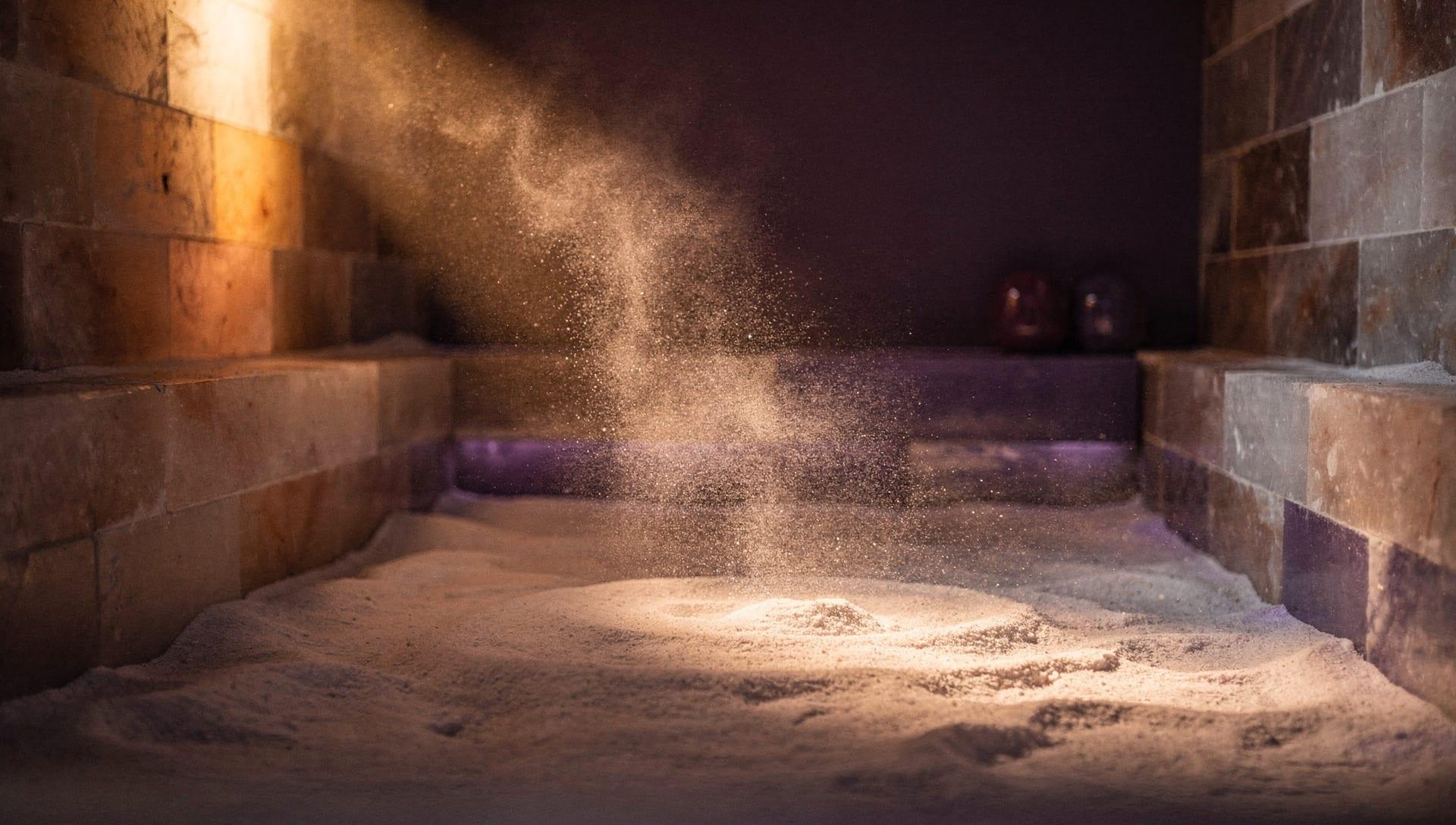
A halogenerator grinds pharmaceutical-grade salt into a very fine dry aerosol you breathe normally during a seated session of 20 or 35 minutes. The working theory: salt is hygroscopic, meaning it draws moisture, and the proposed effect is thinning mucus and easing its clearance from the airways. The mechanism is plausible; the proof, as you'll see next, is thin. We tell you both halves of that sentence on purpose.
What does the evidence actually show?
Three honest layers. First, halotherapy itself: a 2014 systematic review of salt-room studies for COPD found the trials too small and inconsistent in design to draw conclusions, and a small 2017 pediatric asthma pilot reported preliminary improvements. Promising is the strongest fair word.
Second, the strongest related evidence is medical, not spa: inhaled hypertonic saline, a prescribed misted salt solution, improved lung function and reduced flare-ups in cystic fibrosis patients in a landmark 2006 New England Journal of Medicine trial. Different dose, different delivery, different disease. It tells us salt aerosols can genuinely matter to airways; it does not prove a salt room does the same.
Third, long COVID specifically: the published wins are breath-focused, not salt-focused. A randomized trial in The Lancet Respiratory Medicine in 2022 found that an online, singing-based breathing program improved the mental side of quality of life, and breathlessness when running, for people with long COVID. That supports working with your breath in a calm setting; it says nothing directly about halotherapy. No published trial has tested salt rooms for long COVID, and we will update this page when one does.
What do people actually report?
One reviewer of a salt studio in Acton, Massachusetts, wrote that asthma makes breathing hard for them, and that in the salt room they finally felt what normal breathing is like, then fell asleep there. That reviewer has asthma, not long COVID. In an online long-COVID group, one member wrote that salt leaves their whole breathing system calmer and less reactive, and that it slips back within days when they stop.
Reports like these are common in salt-room reviews and patient groups, and they are experiences, not data. Both things are true: the relief people describe is real to them, and it has not been measured in a controlled trial. You deserve to know exactly which kind of evidence you're acting on.
How do you try it without wasting money?
- Finish the medical workup first, and bring your doctor the question; a two-minute conversation beats a guess.
- Book a single first session, never a package, no matter what any studio tells you.
- Pick one marker before you go: the stairs, the night cough, how the third flight feels. Note it that morning.
- Give it two or three sessions at most before you judge. Nothing after three usually means nothing.
- If it does nothing, stop; one session is a small price for a real answer. If your marker moves, that is the time to look at a pack of visits or the monthly membership on the pricing page.
When is a salt session the wrong idea?
- Fever or anything contagious: stay home, for you and for the room.
- Coughing blood, new chest pain, or suddenly worse shortness of breath: that is a doctor or an ER, today, not a salt room.
- Oxygen dependence or an unstable lung or heart condition: talk to your clinician before booking anything.