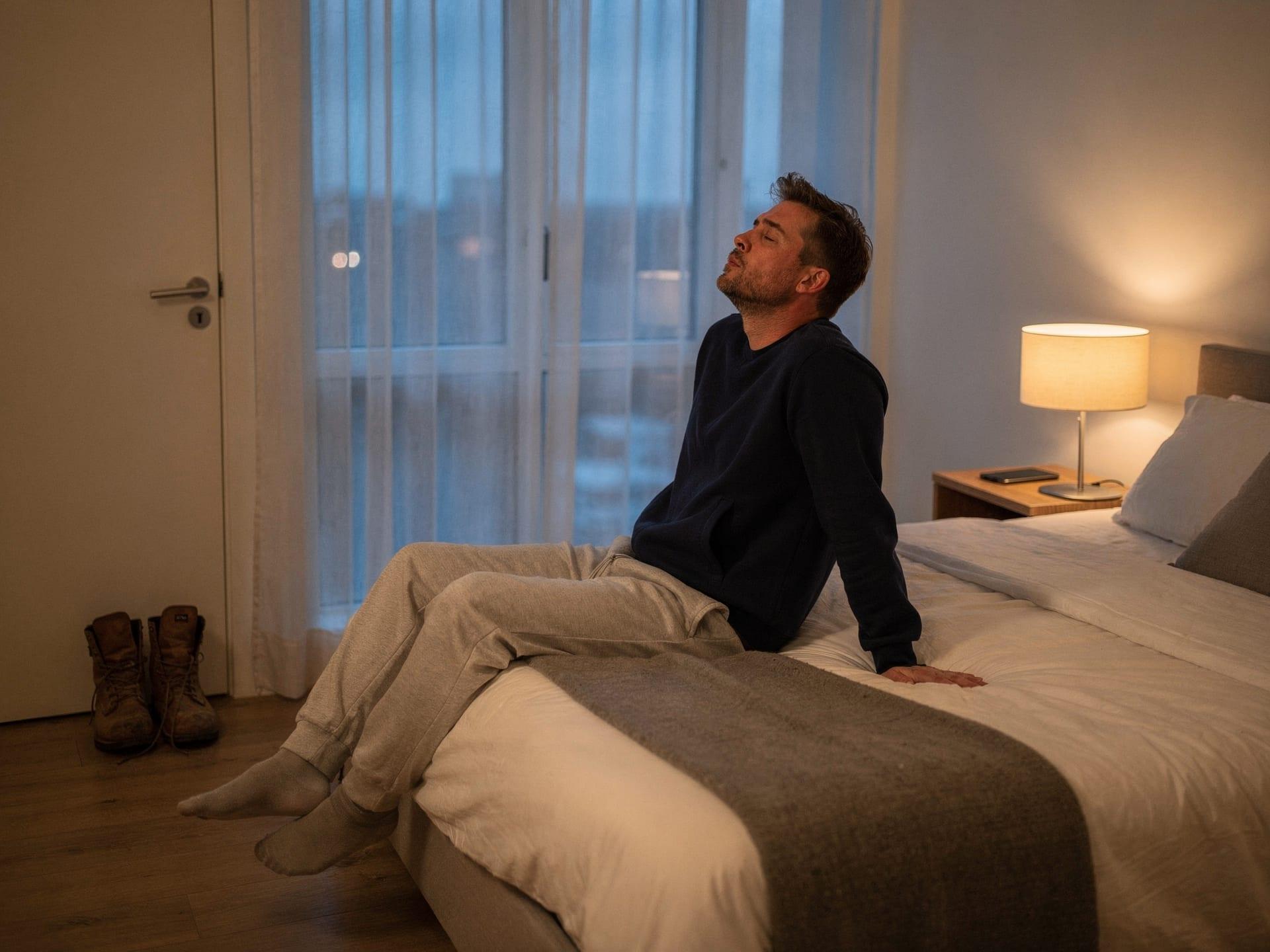
This one is for the people running on empty: the officer coming off a double, the veteran who still sleeps with one ear open, the caregiver, the mom whose kiddo was up again at three. Heather's late husband Tommy served Army airborne, her son is a Marine Corps veteran, her daughter is a police officer, and her youngest son is autistic, so she knows this kind of tired from her own kitchen table. Here is what the salt cabin can honestly offer, how to build an easy evening routine around it, and when a sleep problem belongs with your doctor instead.
Why does stress pile up until rest stops working?
Because most of the people we hear from never get a full reset between hard days. A first responder finishes one shift and walks into the next still carrying the last call. A veteran comes home, and the alertness that kept everyone safe in uniform keeps running in the grocery store. A caregiver sleeps in pieces, between someone else's needs. A mom of a neurodivergent child spends the day on meltdown watch, then lies awake replaying it.
Then the nights go sideways. Exhausted by nine, wide awake at two. You sleep, technically, and still wake up tired. The tank never gets back to full, so each hard day starts a little lower than the one before it.
Who actually comes to salt therapy for stress and sleep?
More people than you might expect. In a Global Wellness Institute survey of 5,000 salt therapy users, published via Halotherapy Solutions in 2023, 58.1% said a breathing condition first got them interested. Another 25.9%, about one in four, came for stress or sleep.
Take that number for what it is: an industry survey, published by an equipment maker, that shows who seeks salt therapy out. Its one results chart is the long-COVID group rating how much salt therapy helped them, a customer signal rather than a measured outcome. So the honest promise is a smaller one: twenty quiet minutes, never a guaranteed night's sleep. What the number does tell you is that you would be in good company, sitting in that room for the quiet as much as for the air.
What makes the salt cabin a restful room?
It asks almost nothing of you. Here is what your twenty minutes look like:
- Your phone stays outside. For twenty minutes nobody can text you, call you, or ask where the permission slip went.
- The light is low and warm, and we set it dimmer or brighter on request.
- The halogenerator makes a soft, steady hum, the kind of background sound many people find easier to settle into than total silence.
- You sit in the clothes you came in, with a fresh blanket over your lap, and walk out the same way.
- Your only job is breathing normally. Close your eyes or watch the glow of the salt wall; either one counts.
- The door opens from the inside, and you can step out whenever you like. Leaving early is a normal outcome here.
For people whose jobs run on scanning the room, that last point matters most. You can see the way out, and you are the one who controls it.
How do you build an easy wind-down routine around it?
Think of salt as the first step of an evening that slows down on purpose, rather than a pill you take at bedtime. Here is a routine you can build at Salt & Soul, one piece or all of them:
- Start in the salt cabin. Twenty seated minutes, phone away, nothing to do.
- If you have the time, follow it with the infrared sauna: 30 or 45 private minutes of deep warmth at a mild 120 to 130 degrees, with chromotherapy in the color you choose and calm sound through the speakers, or quiet.
- Add the Liquid Sound Table, arriving November 2026. You lie back fully clothed on a warm water table while low tones move through it, and the only thing on your schedule is resting.
- Drink some water, take the slow road home, and keep the rest of the night light: an easy dinner, a warm shower, screens dimmed early.
Pay attention to how your own body answers heat. Some people leave the sauna pleasantly heavy, and others feel wide awake for a while, so plan your evening around whichever one you turn out to be. And treat it as a habit. One visit is a nice evening; a standing weekly appointment gives your week a quiet hour it can count on. If the sound table is what caught your eye, our article on vibroacoustic therapy for veterans and first responders covers it in depth.
What about after a long trip or a move?
Military families know this one by heart: the PCS move with three kids and a dog in the back seat, the flight home from a deployment, the long haul to see family over the holidays. First responders travel for training, and SouthCoast families fly out of Logan or Providence every school vacation. You land wrung out, foggy, and a step behind your own clock.
Airplane air is famously dry, which is part of why your eyes and throat can feel parched by the time you land. The National Research Council's 2002 report on airliner cabins put a number on it:
“the relative humidity in most aircraft cabins is low, typically from 10 to 20%”
The day after you get home, a salt session is an easy, quiet reset. You sit, you breathe, nobody needs anything from you, and your body gets twenty minutes to catch up with your watch. It is not a jet lag cure. It is a calm place to land once the trip is finally over.
When does a sleep problem belong with your doctor?
Some sleep trouble needs more than a quiet room. If you snore loudly, if someone has noticed you stop breathing or wake up gasping, or if you nod off at the wheel or at work however long you stayed in bed, tell your doctor. Those can be signs of sleep apnea or another sleep condition, and they deserve a real evaluation. Salt therapy is not a fix for them. The same goes for sleeplessness that keeps getting worse, or nights that come with dread, panic, or flashbacks: your doctor, counselor, or VA care team comes first.
Visiting from Middleboro, Bridgewater, Taunton, or Plymouth?
Salt & Soul sits at 69 Main Street, Unit 5, in Lakeville, on Route 105 at the Middleboro line, an easy evening drive from Middleboro, Bridgewater, Taunton, Plymouth, and the rest of the SouthCoast. Request a session, tell Heather what your nights look like, and she replies personally within 48 hours to help you choose a starting point. First responders and military families save 25% on every session, pack and monthly membership.