This article is for the people who spend their working lives holding it together for everyone else: police, fire, EMS, dispatch, corrections, service members, veterans, and the families who wait up for them. Here is the plain answer about what the table is, what it is not, and what the research does and does not show.
Why do people who carry a lot of stress like a session with no talking?
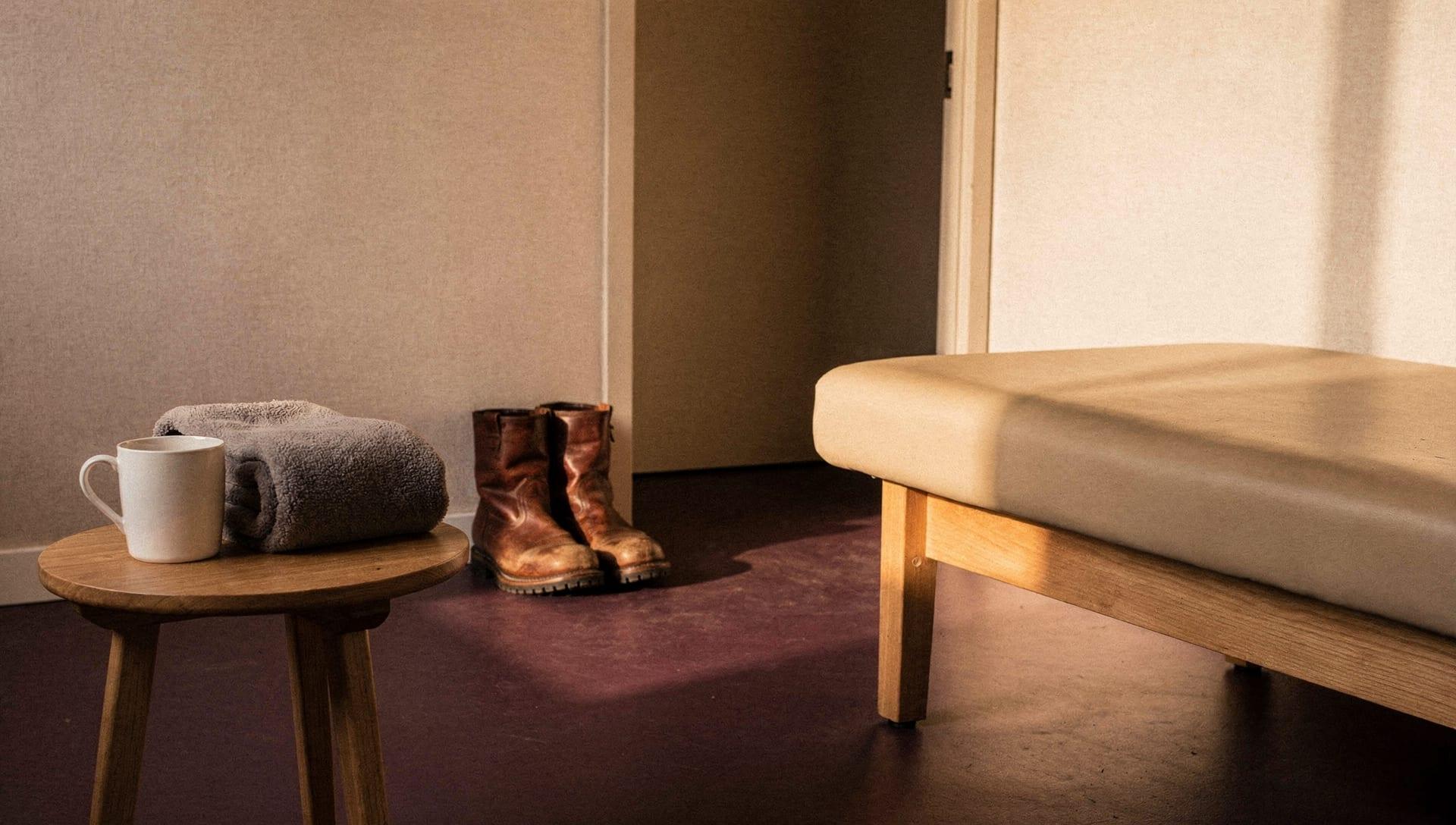
Because most ways to rest still ask something of you. Talk therapy asks you to talk. A group asks you to share. A massage asks you to be touched by a stranger. Even meditation asks you to do it right. The Liquid Sound Table asks for none of that. You lie on your back, fully clothed, on a warm water table, and low tones roll through it while you do nothing at all. There is nothing to explain, nothing to perform, and nobody grading how well you relaxed.
That matters for people whose jobs run on alertness. The table gives the body a quiet, predictable hour where the only job is to lie there, and what you notice on it is yours to keep to yourself.
What does the research actually show?
The honest version, because this audience can smell a sales pitch from across the parking lot. Vibroacoustic therapy has been studied for about 40 years, mostly in small studies of relaxation, stress, and comfort. Small trials have measured relaxation responses, like shifts in heart rate variability, and better sleep scores than a waitlist. The broadest review so far, a 2022 scoping review in BMJ Open, looked at 20 studies of vibroacoustic therapy for adult pain, concluded the evidence was too sparse to pin down what works, and called for randomized controlled trials.
On PTSD specifically: no peer-reviewed trial has tested a vibroacoustic table or bed for PTSD or for veterans. The closest work uses different devices. A feasibility study of a wearable touch-vibration device in 63 veterans with a history of PTSD, registered as NCT05019651, finished in June 2023 and has not posted results. So nobody, including us, can tell you this table treats PTSD. What the research does support is simpler: an hour of warm, low sound where the body gets a chance to stand down.
Researchers in the field say as much themselves. Writing in Music and Medicine in 2012, Punkanen and Ala-Ruona were candid about where the evidence stands: anecdotal reports and case studies are numerous, and there is less evidence from larger scale studies.
What will the session be like?
- You control the room: lights up or down, the door where you can see it, music through headphones or silence.
- There is a clear start and a clear end. Heather tells you exactly how the session opens and closes before you lie down, so nothing surprises you.
- Nothing is asked of you mid-session. No talking, no forms, nobody watching you relax.
- You can stop anytime. Sit up or say the word, and the sound stops. Leaving early is a normal outcome here.
- A session is 35 or 60 minutes with a slow, quiet return, and you walk out in the clothes you came in.
Where has this table been used with veterans before?
In 2015, NBC New York ran a segment on a veterans program at Tournesol Wellness in New York City that featured yoga and the same InnerSoul Liquid Sound Table, according to the table's maker. The maker's music library also includes a track called First Responders De-Stress, composed in 2020. That is the honest extent of the record: other studios have offered this table to veterans and first responders, and at Salt & Soul the real proof will come from Heather's own first sessions after the table arrives in November 2026.
Is it safe for me?
For most healthy adults it is gentle and low risk. Check with your doctor first if you have a pacemaker or other implanted device, a seizure disorder, a history of blood clots, low blood pressure, a recent surgery, or an acute illness. The table is not recommended during pregnancy, and it supports guests up to 300 pounds. If you work with a counselor, a VA clinician, or a peer-support team, tell them you are trying it; it is a relaxation experience that works alongside your care, never in place of it.
Visiting from Middleboro, Bridgewater, Taunton, or Plymouth?
Salt & Soul sits at 69 Main Street, Unit 5, in Lakeville, on Route 105 at the Middleboro line, a short drive from Middleboro, Bridgewater, Taunton, Plymouth, and the rest of the SouthCoast. First responders and military save 25% on every session, pack and monthly membership, and the first responder program page explains who qualifies. Salt & Soul's Liquid Sound Table arrives November 2026; join the First-Session List and Heather will reach out personally within 48 hours.