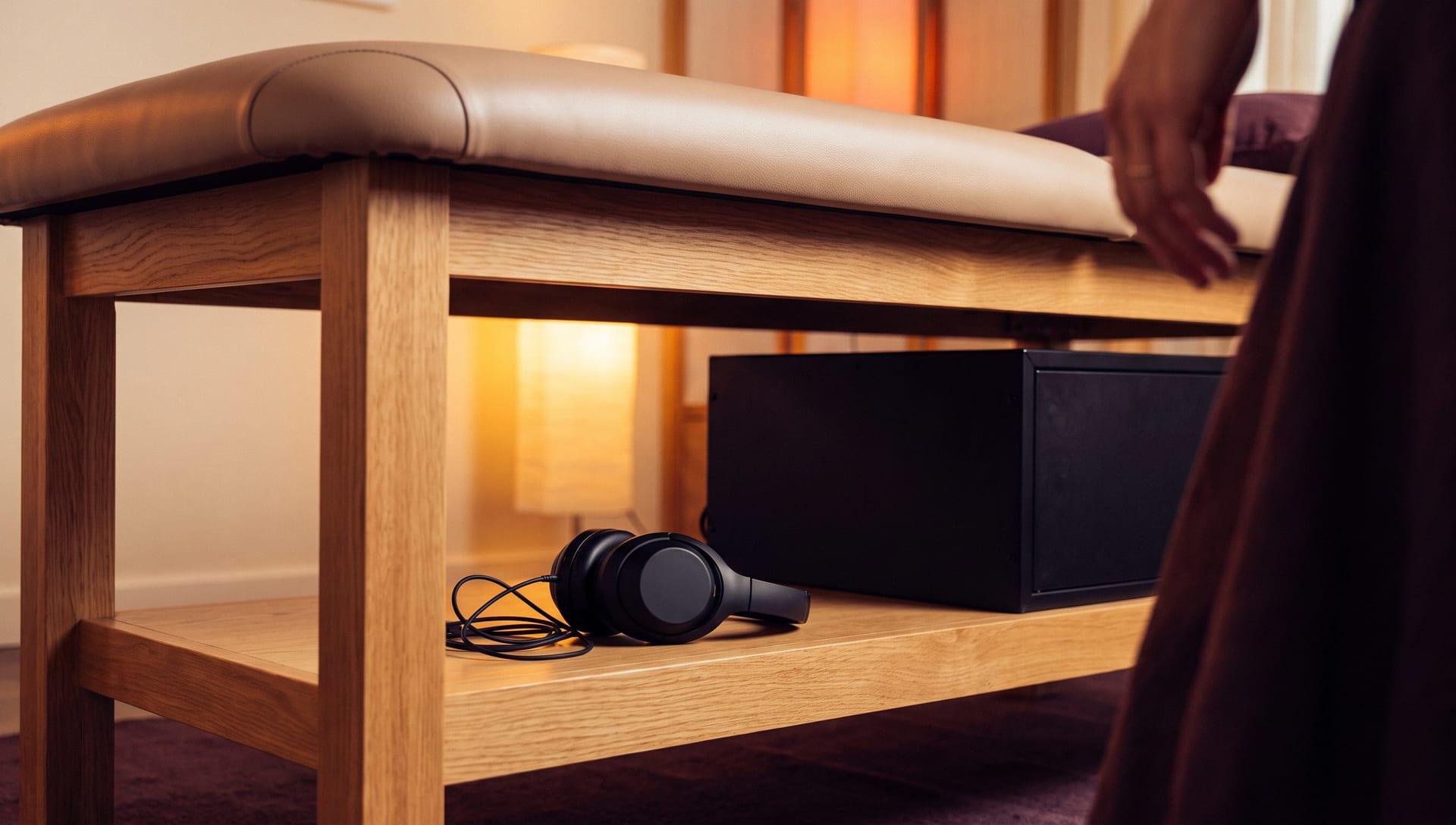
Salt & Soul's Liquid Sound Table arrives November 2026, hand-built for the Lakeville studio by Inner Soulutions, a western New York workshop that has made vibroacoustic tables since 1999. This article explains the whole thing before you ever lie down on one: where it came from, what it feels like, where the research is encouraging, where it is thin, and who should skip it.
Where did vibroacoustic therapy come from?
The approach is older than most people expect. Norwegian researcher Olav Skille and music therapist Juliette Alvin conceived vibroacoustic therapy in 1968, and in 1982 Skille defined it as low-frequency sound waves between 30 and 120 hertz, played rhythmically and mixed with music. In Finland, Petri Lehikoinen developed a related physioacoustic method that scans slowly through frequencies to reach muscles at their own resonance. Skille himself favored a handful of single pitches, especially 40, 52, 68, and 86 hertz, and 40 hertz is still the most common frequency in published studies today.
How does sound turn into something you can feel?
Your skin is full of tiny pressure sensors, and each type listens to its own band of vibration. A 2021 review in the journal Healthcare by Bartel and Mosabbir lays it out: Meissner corpuscles respond most between 20 and 50 hertz, and Pacinian corpuscles between 60 and 400 hertz, which is right where vibroacoustic tones sit. That is why a low tone on the table registers as a soft, rolling hum through your back and legs rather than as noise in your ears. To keep those sensors from going numb, the sound is constantly varied in volume and pitch, so the sensation stays gentle and alive instead of buzzy.
Why a water table instead of a mat?
Most vibroacoustic setups, including the ones already offered on the SouthCoast, use a padded mat or a foam table. The Liquid Sound Table is built around a sealed, 4-inch water bladder instead, framed by thick padded rails and gently heated. Sound travels about four times faster in water than in air, roughly 1,480 meters per second against 343, and according to the table's maker, water carries the vibration evenly across the whole surface, where foam absorbs it and keeps it in one spot. You never touch the water. You lie on top of it, fully clothed, and stay completely dry.
“It is like taking a bath in sound, the best way I have found so far to really experience sound vibration.”
What does a session at Salt & Soul look like?
- Arrive and settle. Heather walks you through the table, asks a few short health questions, and tells you why each one matters.
- Shoes off, clothes on. You lie on your back on the warm, linen-covered surface, with a pillow under your knees and a blanket if you want one.
- Choose your sound. Headphones are optional: some guests listen to music while they feel the tones through the table, and some choose silence and simply feel them.
- Rest. A session is 35 or 60 minutes. The lights, the music, and the pace are yours, and you can sit up at any point.
- Come back slowly. The sound fades, the light rises gently, and you take a minute before you stand. You leave dry, with your hair exactly as it was.
If you ask, Heather can pair a table session with sound healing or a guidance reading. Mention it on your request. A sound healing practitioner who has worked on this kind of table for years describes what it does for the rest of a session:
“It accomplishes in moments what used to take much longer in my sessions: it relaxes people almost immediately. From that place of surrender and deep state of relaxation, I can use my tuning forks and gifts of intuitive healing.”
If you already love the singing bowls, the difference is simple: sound healing is heard in the room, and the Liquid Sound Table is felt through your body. Many guests will want both.
What does the research say, honestly?
Vibroacoustic therapy has been studied in peer-reviewed research for decades, mostly for relaxation, stress, and comfort, and most of those studies are small. A 2022 scoping review in BMJ Open found 20 published studies of vibroacoustic therapy for adult pain, with 40 hertz the most common frequency and sessions running 20 to 45 minutes, and concluded the evidence was too sparse to say which properties help and that randomized controlled trials are needed.
Smaller studies have measured relaxation responses. A 2022 pilot trial in Frontiers in Psychology found heart rate variability changes linked to relaxation in the vibroacoustic group, though stress ratings fell in both groups. A 2020 study in Sleep Disorders reported better insomnia scores than a waitlist. And a 2022 crossover study in Healthcare that included a placebo condition found most differences were not significant, with its authors noting the effects may come from factors other than the vibration itself, like lying still somewhere warm and quiet.
No study has tested this specific water table. So we offer it for what the evidence supports: rest, relaxation, and a quiet nervous system reset, alongside and never instead of care from your doctor. The table's maker puts it the same way.
“The table doesn't treat or cure anything, it offers a held, full-spectrum vibroacoustic field the body can settle into. What people do with that, and what they notice from it, varies.”
Who should skip it or check with a doctor first?
The Liquid Sound Table is gentle, but it is not for everyone. The list below comes from the vibroacoustic research literature, summarized in a 2018 review in the Universal Journal of Public Health, plus the table's own specifications.
- Skip it for now: pregnancy. There are no studies of vibroacoustic therapy in pregnancy, so the table waits until after.
- Ask your cardiologist first: a pacemaker or any other implanted electronic device.
- Doctor first: a seizure disorder, a history of blood clots, a bleeding disorder or blood thinners, low blood pressure, a recent surgery, or any acute illness or inflammation.
- Tell us at your request: sensitivity to vibration or heat (the surface is warmed), or trouble lying flat on your back or getting up from table height.
- The table supports guests up to 300 pounds.
A few people feel drowsy, a little dizzy, or slightly queasy at first, which is why the sound starts low and you can ask for it lower at any time.